


- Home
- Companies
- SCIREQ - an emka TECHNOLOGIES Company
- Articles
- Integrating flexiVent and X-ray ...
Integrating flexiVent and X-ray Velocimetry: Detecting Functional Impairment in Pre-Radiographic Lung Cancer
In the world of preclinical lung cancer research, seeing a tumor is only half the battle. While traditional imaging like microCT can show us where a mass is located, it often fails to tell the full story: How is that tumor actually affecting the animal’s ability to breathe?
A recent pilot study by Smith et al (2025) has broken new ground by combining two powerhouse technologies - the flexiVent and X-ray Velocimetry (XV) - to map the functional decline of the lungs during tumor progression.

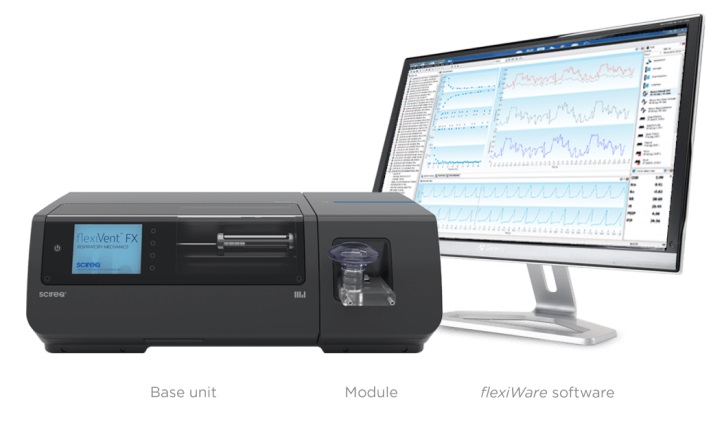
Monitoring lung tumors in mice is notoriously difficult. The lungs are constantly moving, and small tumors can be nearly impossible to distinguish from healthy tissue on a standard scan without contrast agents. Furthermore, standard scans are static; they don’t provide data on lung stiffness or airflow resistance.
To solve this, researchers utilized a mouse model of Non-Small Cell Lung Cancer (NSCLC) and tracked disease progression at two and three weeks using a dual-pronged approach.
1. The Gold Standard: flexiVent Lung Mechanics
The flexiVent is considered the gold standard because it doesn’t just take a quick picture; it measures how the lung behaves under pressure. By using the forced oscillation technique, the study revealed critical shifts at the 3-week mark:
- Reduced Compliance: The lungs became stiffer, making it harder for them to expand.
- Increased Resistance: Airflow faced more pushback within the respiratory system.
- Decreased Vital Capacity: The mice simply couldn’t hold as much air as healthy controls.
2. X-ray Velocimetry (XV)
While flexiVent provides a global view of lung health, XV imaging provides a regional map. XV tracks the motion of lung tissue in real-time to calculate specific ventilation across thousands of tiny points (voxels).
The results were eye-opening. Even at just 2 weeks when tumors made up only 1.5% of the lung area, XV detected localized dead zones.
- Early Detection: XV identified tiny regions of low ventilation that were invisible on standard CT scans.
- Ventilation Heterogeneity: The study found that as tumors grew, the lungs actually became more uniform in their poor function, a sign of widespread tissue stiffness.
This study proves that we no longer have to wait for a tumor to be large enough to see on an X-ray to understand its impact. By using the flexiVent to quantify global mechanical failure and XV to pinpoint exactly where the air stops flowing, researchers can now evaluate new drugs with incredible precision. If a new therapy is working, we should see these “red zones” on the XV map turn “green” long before the tumor physically disappears.
Smith et al. (2025), Mapping lung cancer ventilation dynamics using functional imaging and lung mechanics, Disease Models & Mechanisms, 18(12): dmm052559