


Eurospital Diagnostic Division | Eurospital Spa products
Coeliac Disease - Rapid Tests
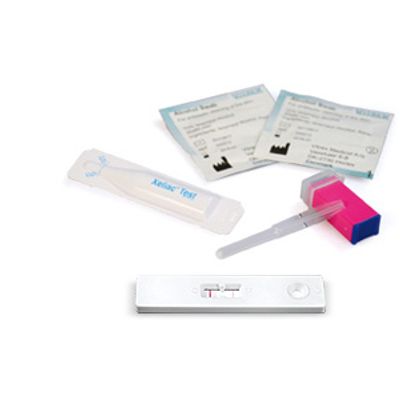
Eurospital - Model Xeliac Test Professional - Rapid Test for the Qualitative Detection
Xeliac Test Professional is a rapid, simple and reliable test for the qualitative detection of IgA and IgG anti-tTG antibodies from a fingertip blood sample.
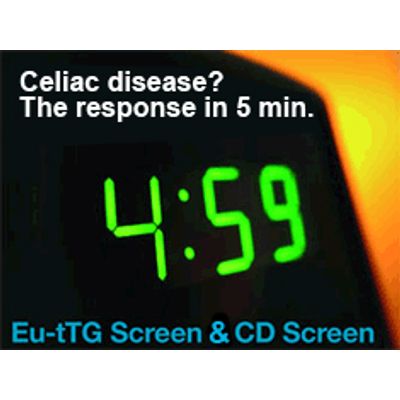
Eurospital - Model Eu-tTG Screen - Rapid Monotest for the Determination of Anti-Transglutaminase Antibodies
The first rapid monotest for the determination of anti-transglutaminase antibodies in human serum.

Eurospital - Model CD Screen - Rapid Monotest for the Determination of IgA Anti-Transglutaminase and Antigliadin Antibodies
Rapid monotest for the determination of IgA anti-transglutaminase and antigliadin antibodies in human serum.
Coeliac Disease - Elisa

Eurospital - Model Eu-tTG - Elisa Test Kit
The identification of tissue transglutaminase as the antigen responsible for endomysial positivity has opened up new horizons for the serological diagnosis of celiac disease. Today the determination of anti-tTG antibodies is the reference test for the diagnosis and follow-up of this disease.
Eurospital - Model a-GliaPep - Elisa Test Kit
The knowledge about coeliac disease has increased a lot during last years. This has been possible due to the availability of new and more specific in vitro diagnostic medical devices.
Model a-Gliatest - Elisa Test Kit
At the beginning of the nineties, the antigliadin antibody assay (AGA) was first used in studies on the prevalence and incidence of celiac disease. Before those studies, this disease was considered to be rare and its incidence was underestimated (1:1000/2000). Later, the study carried out at the University of Ancona showed a much higher prevalence (1:183) thereby revolutionising the knowledge on the disease and redefining its actual extent. The discovery of antiendomysium antibodies and, later, the anti-transglutaminase antibodies played down the role that these antibodies have in celiac disease diagnosis.
IFA
F-actina
Celiac disease (CD) is a permanent, immuno-mediated, gluten-dependent enteropathy, which affects genetically predisposed individuals. A cascade of gluten-induced immune reactions is associated with the appearance of specific circulating autoantibodies and with characteristic lesions of the small intestinal mucosa. It has been recently demonstrated that Coeliac patients have circulating autoantibodies specifically directed against intracellular actin filaments which correlate with the degree of mucosa villous atrophy. According to a recent study, anti-actin antibodies were positive in 98.2% of the CD patients with flat mucosa and in 89% with subtotal villous.
Antiendomysium
The search for antiendomysium antibodies is an indirect immunofluorescence assay (IFA) test with high sensitivity and specificity values. To obtain accurate results, however, high-quality biological materials (e.g. deep-frozen sections of monkey oesophagus or human umbilical cord) as well as expertise in result interpretation of the assay (fluorescence interpretation) are required.
Genetics
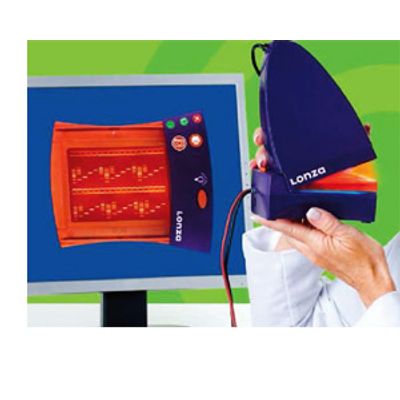
Eu-Gen System
From the exclusion of coeliac disease to the definition of relative risk. The Eu-Gen System, molecular biology system, allows to define the HLA genotypes associated to coeliac disease by means of a step-by-step approach according to the specific requirements of each user.

Model XeliGen - Molecular Biology Kit
Molecular biology kit for the determination of susceptibility to celiac disease by Real Time PCR amplification of human DNA from peripheral blood and further identification of specific alleles for this condition. Genotype, Risk, Prevention. The most innovative feature of XeliGen is the identification of subjects who are at risk of developing coeliac disease. By using XeliGen is possible to detect the main HLA genotypes that predispose to susceptibility to coeliac disease and, therefore, it is possible to stratify the genetic risk to identify (especially in subjects already belonging to at-risk category) those individuals who have an higher probability of becoming coeliac.