


- Home
- Companies
- Weber Entec GmbH & Co. KG
- Products
- Weber Entec - Model DesiUS - ...
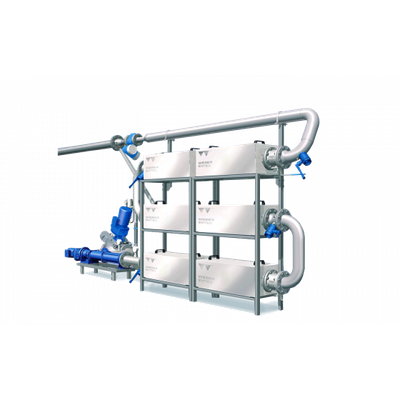
Weber Entec - Model DesiUS -Disintegration Ultrasound System
The term “DesiUS” stands for “disintegration ultrasound system”. The disintegration process which forms the basis of DesiUS was developed by Weber Ultrasonics in collaboration with the Fraunhofer Institute, and was optimised by Weber Entec through the use of the BioPush reactor. DesiUS (Disintegration Ultrasound System) represents energy-efficient and process-robust cell opening technology combined with exceptionally high efficiency. The robust and completely maintenance-free construction of the BioPush reactor allows a simple and uncomplicated structure. The ultrasonic reactors of the turnkey constructed plant are charged via a screw pump. The substrate is routed through the sound field at a specific speed in such a manner that the specific energy input required for treating the substrate is ideally achieved.
Ultrasound disintegration for biogas plants and WWTPs
Disintegration means the breakdown of biogenic sludge into minute particles by external forces. The resulting increase in surface area causes an acceleration of the organic breakdown process, and thereby results in an increased biogas yield.
In addition, the release of exo-enzymes from the external cell layer increases the enzyme activity in the digester.
In ultrasonic disintegration, the electrical oscillations created by a generator are transformed by a converter (sonic transducer) into mechanical vibrations. These vibrations are transferred into the surrounding medium by means of a device known as a sonotrode. Following the rhythm of the ultrasonic frequency, they cause high alternating positive and negative pressure phases, depending on whether the oscillator is expanding or contracting at the time. During the negative pressure phase, microscopical cavities are formed in the liquid exposed to the ultrasonics; these then collapse in the subsequent positive pressure phase. This process is known as cavitation. From the implosion, which releases high pressures and temperatures, strong impact and shear forces occur in the area immediately around the cavities, and these cause the surrounding micro-organisms to disintegrate.
The core of the DesiUS is the ultrasonic technology from Weber Ultrasonics. The BioPush reactor developed specifically for the treatment of biogenic slurries fulfils the demanding requirements of the disintegration process, and in many aspects is significantly better suited than the usual rod transducers or sonotrode technology.
- Temperatures of up to 5.000 °C
- Pressures of up to 1.000 bar
- High accleration – high shear forces
To prove the homogenity, a metal structure wrapped with aluminium foil is placed into the with water filled reactor. After 15 s of ultrasound treatment, the structure will be taken out and the aluminium foil shows a homogenous destructions pattern on all four sides.
 Plant control and remote access
A PLC-supported control system enables robust and trouble-free operation.
The drawing shows the simple and therefore error-free structure of DesiUS. The plant consists of a macerator, a screw pump, in this case two ultrasonic reactors, flow quantity measurement devices, and pressure and temperature sensors (two each). The control cabinet with the PLC control system may be installed in a remote location, or directly on the plant.
A REVIEW
traditional technology: rod transducers
In traditional systems, damping of the cavitation performance increases with the solids concentration. Frequently, therefore, biomass is treated only if it is in the immediate proximity of the ultrasound source.
Lasting time of rod transducers in sludge applications is between six month and two years, depending on the properties of the sludge. Additionally already after a short period of time, rod transducers require extensive maintenance.
- Very high energy efficiency – 50 % saving compared to other disintegration systems
- Extremely low-maintenance plant technology
- High degree of operational reliability
- Long standing times
- Can be ideally adapted to the respective requirements
- Lower space requirement thanks to compact design, simple plug & play installation
- Quick pay back
LONG LIFETIME, OPERATIONAL RELIABILITY and ZERO MAINTENANCE
The BioPush Ultrasound reactor solves the problems of the other disintegration systems. Because biomasses with a typical solids content between 8 % and max. 13 % have a relatively high viscosity, more effort is usually required in traditional plants in order to ensure an effective coupling of the ultrasound to the medium. Because the cavitation performance of the ultrasound becomes more damped as the viscosity of the medium increases, the medium must therefore be passed as close as possible to the sonotrode. Although this could be achieved constructionally by means of a sufficiently small pipework cross-section, it is not possible to implement it in this way, because the sonotrodes tend to become affected by blocking and “tressing” from fibrous components, both in substrates from biogas plants using renewable raw materials and also in sewage sludges. The results are a high level of sound damping, and therefore reduced energy efficiency.
The BioPush reactor developed by Weber Entec specifically for the treatment of biomasses tackles this problem. The structure practically precludes blockages and tressing. The working life of the BioPush reactor is several times longer than with classical rod sonotrodes in the biomass area.
What is so special?
The core technology of DesiUS is the ultrasonic technology from Weber Ultrasonics. The BioPush reactor, which was specially developed for the treatment of biogenic sludges, takes into account the high requirements placed on the disintegration process and in many aspects is significantly better than the conventional rod transducer or sonotrode technique.
In the early days of ultrasonic disintegration, the use of the rod transducers technology turn to be problematic because of the enormous wear and the use of the sonotrodes in the biomass field.
These findings led to a rethinking at Weber Entec and Weber Ultrasonics. A reactor specifically designed for the treatment of biomass has been developed.
The problems of traditional rod oscillator technology listed below arise mainly because of the direct contact of the sludge with the rod transducer. The aggressive cavitation force, which is wanted and required to achieve the intended effect, inevitably leads to an unstable process in the biogenic sludges.
That’s why Weber Entec has developed the BioPush reactor. The innovation of this approach is that the ultrasound is fixed on the outside of the reactor and thus no disrupting/interfiering body is left in the medium to be treated.
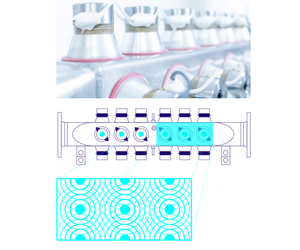
Through its high-performance surface transducer, the BioPush reactor generates a homogeneous cavitation field within the reactor. The reactor body is rectangular and hosts 6 ultrasound transducers on each side. The 24 ultrasound elements cause the entire body to “swing” with a frequency of around 22 kHz, which virtually quadruples the amplitude.
The effect of the sludge is at least as high as with the standard rod transducer technology but the entire reactor is 100 % maintenance free and has a durability of three years and more. Even problematic substrates such as highly thickened mixed sludges from waste water treatment plants or from agricultural fermentation plants are treated at maximum performance. In traditional ultrasonic reactors, there is usually direct contact between the sonotrode and the substrate, and this inevitably results in continual gradual wear of the sonotrodes. At the start, these plants often produce the same performance as the BioPush, but this rapidly falls off noticeably, because tressing builds up rapidly on the sonotrodes, which are inevitably damaged by cavitation, and this causes damping even to the extent of complete acoustic insulation.
Technical Characteristics of the BioPush Reactor:
- Up to 25 % more biogas (proven many times over)
- 2,000 W ultrasound performance per ultrasonic reactor
- Treatment of substrates with up to 15 % solids content
- Mechanical pretreatment optional
- Easy adaption to dynamic flow rates
- Optimum energy input thanks to homogeneous, contact-free sound field
- Compact structure
- Can be cascaded as desired
- Plug & play